Wednesday, October 15, 2014

Raptor and non-raptor count summaries, 7-14 October 2014


This has been another great week at Hawk Ridge, filled with a great diversity of raptors and fantastic fall color. Raptor migration has been steady. From 3-10 October we had a very prolonged period of NW winds, and the raptors responded to these ideal conditions, with over 1,000 hawks counted for six days in a row from 4-9 October. The majority of this flight has been Sharp-shinned Hawks, but good numbers of most other species have been seen as well. A high diversity of raptors is typical for this period in early October when early season species such as kestrels and broad-wings mix with late season species such as Rough-legs and Golden Eagles. In late September we began seeing noticeable numbers of adult male Sharp-shinned Hawks, so it seemed that perhaps the end of the Sharp-shin migration was nearing (adult males are the last age group to come through), but all week we have been amazed at the number of Sharpies zooming through, most of which are adults, and many of which are adult males. The peak for Sharpies was on October 8th when 1185 were counted. Other accipiters were plentiful all week as well, including 16 Cooper’s on October 8th and 18 Northern Goshawks on October 9th. An adult Red-shouldered Hawk flew over the ridge on 14 October, the second Red-shoulder of the season. During the next few weeks, we should see peak numbers of goshawks, Golden Eagles, Bald Eagles, and Red-tailed Hawks. It’s a very exciting time of year at Hawk Ridge!

juvenile Northern Goshawk flying directly in front of the counting platform- too close to fit in the frame! It has been a great week for goshawks- although most have juvenile birds like this one, three adult-type birds have also been seen

Adult Sharp-shinned Hawk going for the owl decoy! Rather amazing numbers of Sharpies have been moving through, including a peak of 1185 on 10 October, most of which were seen before noon, including a peak hour of 313 (!) , when the gangs of Sharpies lining the Ridge looked almost like migrating robins
One of the highlights of the week was this adult Red-tailed Hawk which made several passes at the owl decoy right in front of a crowd of visitors!
Non-raptors have been relatively quiet this last week, following the amazing multiple-day flight of 3-6 October detailed in last week’s blog. In some ways it was a relief to see all those birds finally move on, since there was such high mortality among the ones that had been littering local roadsides for so many days. I am still puzzled why so many Yellow-rump and Palm Warblers took to feeding along the busy roadways. The highlight of the week was clearly the kinglet and creeper migration, something that had not been detected in such numbers here before. In the last ten days nearly 1,000 kinglets have been seen, which is more than ten times the number found in previous seasons. The peak flight was on 7 October when 262 Golden-crowned Kinglets (record high count for the state), 44 Ruby-crowned Kinglets, 153 unidentified kinglets, and 29 Brown Creepers were all seen. Most of this kinglet migration has been on the shore, where it occurs low in the trees or just above the trees.

Ruby-crowned Kinglet migrating just above the trees
Golden-crowned Kinglet migrating just above the trees. Although many kinglets were too quick to be identified, the face pattern between the two species was surprisingly easy to see in flight. Golden-crowns seemed much more likely to call than the Ruby-crowns, which helped when counting 262 Golden-crowns on 7 October!
 American Crow numbers have been building and will likely peak in the next week or two, when days of multiple thousands are likely. A set-up flight of 1,166 was tallied on 14 October. We continue to see more Common Ravens than usual, including 78 on 9 October and 74 on 10 October.  If this pace continues, we may see a record number of ravens by the end of the season, since the peak migration is usually not until late October or early November. A total of 750 ravens have already been counted. Purple Finches and Pine Siskins are moving in good numbers as well, including 506 Purple Finches on 10 October and 649 Pine Siskins on 11 October, but since finch flights are so unpredictable, its not clear whether more are to come or they have already peaked. Over 250,000 non-raptors have been counted this season so far, and there are many more to come! In the next few weeks we will see the tail end of American Robins, Eastern Bluebirds, Rusty Blackbirds, sparrows, etc., but we expect to see some later season species such as Snow Buntings, Pine Grosbeaks, Common Redpolls, and Northern Shrikes.

Fox Sparrow migrating over the trees. We have seen a surprising number of sparrows engaging in morning flight this year, many times more than previously. Over 50 Fox Sparrows have already been counted this season.
Dark-eyed Junco migrating overhead. Many more juncos have been seen migrating than usual, including some that  have been quite high. On 14 October with north winds, we saw many flocks of juncos high overhead! Nearly 3,000 juncos have been counted so far this season, and we will hopefully get another wave in the next few weeks.

American Robin flashing its red breast and underwings as it migrates by. This species is usually are most common migrant, and this year is no exception- over 60,000 have been counted so far, including an awesome flight of 23,395 on 4 October (third highest count to date)
view from the summit at Hawk Ridge in evening light with fall color
photos and text by
Karl Bardon
Count Director
Hawk Ridge Bird Observatory

Tuesday, October 14, 2014

Hawk Ridge Banding Report, October 1-10, 2014

Passerine Banding Report

October blew in hard, and summer birds have moved on through, changing the look of the passerine banding season from large numbers of warblers to the later season birds: kinglets, thrushes, Brown Creepers, Winter Wrens and sparrows. 121 passerines were banded between October 1-10 of 19 species banded during 4 days. Promptly on October 1, the first Fox Sparrow of the season was banded and 4 more on the 6th. Ruby-crowned Kinglets with 30 caught, as well as 8 Golden-crowned Kinglets have dominated the nets during this period. 

Passerine banding for the public at the overlook took place on Oct. 5th, yielding 28 birds. Most of these were caught in the first run or two of the mist nets before high winds necessitated closing the nets and switching to walk in traps. 13 White-throated Sparrows were banded along with 3 Fox Sparrows, 1 Black-capped Chickadee and 1 Yellow-rumped Warbler.
Blue Jay (Miranda Durbin)

 
Hairy Woodpecker (Nova Mackentley)

Margie Menzies
Hawk Ridge Passerine Bander/Naturalist


Owl Banding Report

The owl migration has certainly picked up during this period and seems to be in full swing now. Owl monitoring sites in eastern Canada and the northeast states have all reported slow starts to the migration as well. Between October 1-10, a total 286 Northern Saw-whet Owls were banded which brings the season totals to 420. The peak nights thus far were on the 6 and 10, October with 69 and 100, respectfully. Currently the age ratio of hatch-year birds is 57%  for the season.

Long-eared Owls are also picking up now with 5 banded during the period and bring the season total to 8. All have been hatch year birds. 

Northern Saw-whet Owl - second year (Miranda Durbin)

 
Long-eared Owl (Madison McConnell)

Madison McConnell
Hawk Ridge Owl Bander


Raptor Banding Report

The hawk movement was certainly good during the period when a system just north of us produced westerly winds from the 3-10, October which resulted in 673 hawks banded and included the following: Bald Eagle-4, Northern Harrier-6, Sharp-shinned Hawk-596, Cooper’s Hawk-11, Northern Goshawk-22, Red-tailed Hawk-29, American Kestrel-2, Merlin-2, Peregrine Falcon-1.
Adult Bald Eagle (Frank Nicoletti)

Adult Red-tailed Hawk, rufous morph (Chris Neri)

Hatch-year Red-tailed Hawk, rufous morph (Kaitlin Alford)
Hatch-year Bald Eagle (Nova Mackentley)

An update on the Turkey Vulture tagged in August in West Duluth. It started migrating on 4 October and its last location was 41.52883, -91.12217, 28 mi west of Davenport, Iowa where it roosted the night of 8 October. I will continue to update the movements during the fall migration and report on its wintering locations.


Frank Nicoletti
Hawk Ridge Banding Director

Monday, October 13, 2014

Count Interpreter... What's That??

The answer to the question posed as the title of this post is quite simple, but also misleading. My job as the Count Interpreter at Hawk Ridge is not to count birds, as that is the job of the counters, but to interpret them. Interpreting is an interesting piece in and of itself. What do I say about birds? What is useful to know? When can I stop talking about Sharp-shinned Hawks? 

Northern Shrike - Clinton Nienhaus
Generally, my approach is to address the bird as I see it and as the viewers up on the Ridge see it. I take the bird and break it down to what it is and why it is. Sometimes the birds are cooperative and I can call out marks A, B, and C of a Sharp-shinned Hawk or of a Red-tailed Hawk, but other times the birds are not. They  sneak out of view and I am cut-off, hoping for another flyby and nice view for the folks up on the ridge. I often consider that most of the folks I have been in contact with up on the Ridge do not have the ready access to sharpies as we do in the north woods. In the Twin Cities for example, there are no breeding sharpies, instead they are replaced by Cooper's Hawks. So for me, a bird that is dime-a-dozen may be out of the ordinary for other folks. Knowing this makes my interpreting of hundreds of sharpies a day, not monotonous, but valuable!

Birds are the main reason people come up to the Ridge, but for me, the people that come up to the Ridge are just as interesting. I hope that through conversations I can cater my interpretation of the birds overhead to their knowledge level or interest. But more frequently, I hope that there are good birds flying to give people a life bird, or a special memory of their time at Hawk Ridge.

On 10/9 we had a Golden Eagle fly over. He (or she) was very high in the sky and was in view for seemingly minutes. I did my shtick of describing the bird as it was flying, being sure to note the flight shape and characteristics versus the far more common Bald Eagle. After a while I ran out of things to say and just sat back to watch the bird soar very high in the sky and ultimately out of sight.  A couple hours passed and an older fellow, who seemed to me to be a lifelong birder, passed by me on his way out and mentioned, very wild eyed and reverent, that the golden eagle that had flown over was the first he had ever seen. I can still picture his expression of pure contentment with his experience. I know that it did not matter what I had said about that bird, for him, it was the bird itself.
Sometimes, interpretation is not saying anything. Just pointing out a bird for people to see. To enjoy. To marvel at its mastery of flight. I hope that I can point out those things and help foster that sense of appreciation and awe in birds. And, I guess if someone takes an ID point or two away that is equally as valuable.   
Clinton Nienhaus
Hawk Ridge Count Interpreter

Tuesday, October 7, 2014

Hawk Ridge Volunteer Weather & Raptor Forecast


By Katie Swanson, Volunteer Director

Each year at Hawk Ridge we have new volunteers that come onto our team. They come from all different walks of life and have many different goals while volunteering at Hawk Ridge. They also bring a lot of unique passions and skills to the table.

This year, we have a new volunteer named, Scott Palacheck. He has been coming to the Ridge for many years and felt inspired to finally become an official volunteer. Scott volunteers at the Ridge at least once a week. He is great at talking to visitors, pointing out birds and helping us do traffic control. These are all very needed tasks at the main overlook. However, Scott has brought a more unique passion to Hawk Ridge this year. He is an amateur meteorologist. Scott has shared a few weather forecasts with the volunteers and staff, but would also like to share his thoughts with the public. Here is Scott's weather/raptor forecast for the next few days below.

Greetings fellow birders, this is Scott Palacheck reporting from the HRBO weather desk.

Mother Nature will keep the cool air flowing from the WNW at a steady 10-15mph until Friday. This should keep the birds moving south and pushing them closer to us at Hawk Ridge. The temperatures will range in the low to mid 50's during the day with part sun and part clouds. The sun should create some thermals and encourage the birds to keep moving.

To stay warm and comfortable on the ridge during the week, bring outdoor fall weather wear, such as a fleece and medium hooded jacket that will also protect you from the wind. Don't forget to bring something to keep your head and hands warm as well.

If coming to the Ridge closer to the weekend, bring your rain gear, as well as your warm clothes. Saturday and Sunday will top out in the mid 50's with a 50/50 chance of rain. The winds will shift to the S and SW so the birds may slow down a bit but we can hope to see them flying lower those days.

Lets keep rocking the Ridge before mother nature kicks us off for the season!

Monday, October 6, 2014

Raptor and non-raptor count summaries 1-6 October, 2014

This afternoon, I told a visitor, wondering how long we count each day, that we try to stay out as long as migrants are moving. What a audacious statement; birds are on the move around the clock! This time of year, the fun never stops! Visible migration continued to amaze observers this past week on Hawk Ridge and along the north shore of Lake Superior.

The first two days of October were rather uneventful. A rainy day on 1 October allowed counters and others to re-group (do laundry) and prepare (more laundry) for the next onslaught of migrants! The second was very quiet with only 28 raptors tallied. A late Common Nighthawk was observed on the afternoon of the second making multiple passes at a Monarch butterfly, but repeatedly decided against ingesting it. That evening brought a drastic change in weather with very strong NW winds, rain, and falling temperatures. The cold front had arrived!

American Robin. Tens of thousands of these beautiful birds washed over Duluth in the past week.
Following the passage of this front, the north shore of Lake Superior got walloped by birds beginning on the morning of 3 October with lots of birds continuing in the area through 6 October. The very strong winds and drizzly conditions put birds down in large numbers in any (even somewhat) suitable habitat. Non-raptor highlights of this major push of birds were many, but included:

A three day total of 43,543 American Robins (peak flight of 23,395 on 4 October).

A three day total of 7,811 Rusty Blackbirds (peak flight of 4,956 on 4 October).

405 Northern Flickers on 4 October.

Over 4,000 warblers (mostly Yellow-rumped Warblers, but with good numbers of Palm Warblers and quite a bit of straggling diversity) on 4 October.

Literally thousands of sparrows (especially White-throated Sparrows and Dark-eyed Juncos but with good numbers of Fox and White-crowned Sparrows) lining streets and yards throughout the city.

494 Purple Finches on 5 October.

Over 100 Golden-crowned Kinglets on 5 October.

Immature Red-tailed Hawk. Note the pale primary panels (it helps to squint a bit) and banded tail.
The overcast skies and drizzle kept raptor movement on 3 October rather modest compared to the non-raptors with a day count of only 247 hawks. The next three days, however, all produced flights of over 1,000 raptors!

The peak flight of the last week was 1,816 raptors on 5 October. Highlights of the day included 277 Bald Eagles, 752 Sharp-shinned Hawks, and the first Rough-legged Hawk of the season, an adult female. Red-tailed Hawks also put in their best showing to date with 187 tallied and small numbers of Broad-winged Hawks are still straggling through.

Raptor flights from 4-6 October produced three day totals of 1,909 Sharp-shinned Hawks, 515 Bald Eagles, and 238 American Kestrels among 3831 raptors!

Here are a few photos from the past week or so to take it away...

Merlin bombing past the platform

Six Snow and four Ross's Geese. Note the smaller bill and shorter neck of the Ross's Geese.
Red-breasted Nuthatch casting it's gaze down the ridge

Male Black-backed Woodpecker!

Steve Kolbe
Assistant Counter

Hawk Ridge Banding Report 9/21-9/30 & monthly totals

Passerine Banding Report

An increase in the number of days covered and higher numbers of passerines banded this season are due to the hard work of David Alexander and Margie Menzies. They are continuing the process of training new volunteers and spending more time banding. We are looking forward to making this a larger part of the overall banding research at Hawk Ridge with specific projects and goals to increase our knowledge of passerine migration that occurs.

During the period of September 21-30, 317 birds of 43 species were banded with 7 days of coverage. Highlights included 5 Brown Creepers, 2 Orange-crowned Warblers, 1 Connecticut Warbler, 2 Golden-crowned Kinglets, and the season's first Winter Wren on the 30th.
Hatch-year female Pileated Woodpecker (Miranda Durbin)
Brown Creeper (Margie Menzies)
Blue-headed Vireo (Margie Menzies)
The monthly totals for September are 1,021 birds banded of 53 species with 18 days of coverage.

Margie is also doing an educational banding program at the overlook every Sunday (weather permitting) during the season to introduce visitors to the banding process and the importance of banding research. This has also provided a great opportunity for visitors of all ages to come out to view these little jewels that migrate through the Ridge. The numbers banded from overlook were 80 birds of 18 species among the 3 days of banding thus far.

Margie Menzies
Hawk Ridge Naturalist/Passerine Bander
Owl Banding Report

The owl migration started off slow, but picked up toward the end of the month. A total of 134 Northern Saw-whet Owls and 3 Long-eared Owls were banded during 15 nights of operation. Owl banding started on the 13th. Northern Saw-whet Owl age ratio is nearly 50% hatch-year, which is sharply different compared to last fall at this time when there was no hatch-year by this date.  The 3 Long-eared’s have all been hatch-year as well.
Madi looking for molt (Karen Stubenvoll)


Madison McConnell
Hawk Ridge Owl Bander

Raptor Banding Report

The hawk banding was good during the period of September 21-30, with fair weather and good movements on southerly winds. Among 476 hawks banded during the period were the following: Northern Harrier-10, Sharp-shinned Hawk-407, Cooper’s Hawk-6, Northern Goshawk-9, Re-shouldered Hawk-1 (4 record), Broad-winged Hawk-4, Red-tailed Hawk-5, American Kestrel-5, Merlin-26, and Peregrine-3.


Red-shouldered Hawk (Miranda Durbin)

Cooper's Hawk, ASY-F (Chris Neri)
Northern Harrier, ASY-F (Chris Neri

Peregrine Falcon, HY-female (Chris Neri)

A total of 1847 hawks have been banded during September and are as follows: Bald Eagle-3, Northern Harrier-26, Sharp-shinned Hawk- 1,648, Cooper’s Hawk-20, Northern Goshawk-11, Red-shouldered Hawk-1, Broad-winged Hawk-14, Red-tailed Hawk-16, American Kestrel-27, Merlin-74, Peregrine Falcon-7.

As with a project this large, there are many staff, volunteers and others who make it all happen. I want thank all involved in making this project a success.

Frank Nicoletti
Hawk Ridge Banding Director


Wednesday, October 1, 2014

New Faces at Hawk Ridge, Fall 2014


On behalf of the Board of Directors of Hawk Ridge Bird Observatory, I want to welcome our new staff members who have joined us this fall. There have been many familiar faces at the overlook, but also some new ones, and I'd like to introduce you to our enthusiastic new staff.

Steve Kolbe, Counter, came to Hawk Ridge from the Derby Hill hawkwatch. He is a native of Ohio, and has counted migrating raptors throughout the eastern U.S.A. Steve is super excited to be counting hawks and other birds in Duluth; in fact he has helped set new Minnesota records already this season, including Blue Jays and White-throated Sparrows.

Steve, looking for jaegers at Wisconsin Point, photo by Karen


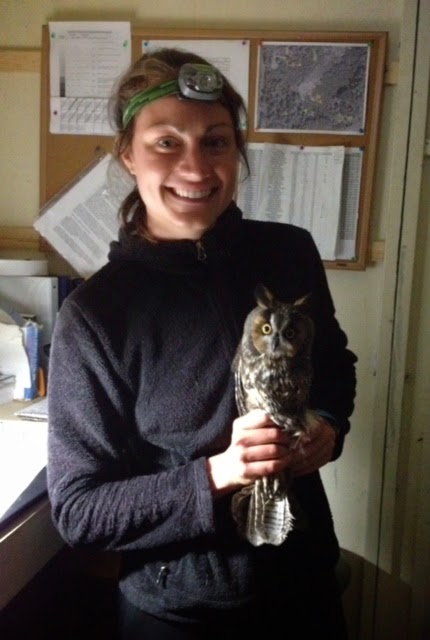
Madi McConnell is our Owl Bander; she is a native of Pennsylvania, and has worked with Snowy Owls in Alaska, Long-eared Owls in Montana, and Northern Saw-whet Owls at Hawk Mountain, Pennsylvania; she also had an awesome experience working with seabirds in Antarctica. Madi is thrilled to be at Hawk Ridge this year for the owl migration.

Madi with Long-eared Owl, photo by Karen


Clinton Nienhaus is our Count Interpreter and also a Naturalist. A native of Winnebago, MN, he also serves on the board of the Duluth Audubon Society. He's the guy calling out helpful tips on hawk ID at the overlook and teaching visitors how to distinguish a Cooper's Hawk in flight from a sharpie, for instance. You can join Clinton for the Autumn Songbird Strolls on Park Point, 7 am Friday mornings at the end of the paved road at Sky Harbor Airport parking lot. 

Clinton at Hawk Ridge overlook, photo by Karen


Allie Quick, from Superior, WI, is a Naturalist. Allie loves her job and it shows in her friendly &  enthusiastic interactions with visitors at the overlook.

Allie with Northern Harrier, photo by Hawk Ridge staff


Kaitlin Alford is our Banding Trainee; she is a native of the state of Virginia and has also done field work in Australia. Kaitlin is getting plenty of hands-on experience in the banding station, and is hoping to use this experience to pursue a career involving wildlife or environmental education.


Kaitlin with Peregrine Falcon, photo by Miranda Durbin


Julia Luger is our Education Trainee; she is a native of Minnesota (the Twin Cities area), and had already been very familiar with Hawk Ridge as a volunteer both at the overlook and in the office. It's great having Julia lending her expertise with our education programs.


Julia at Hawk Ridge overlook, photo by Karen


In recognizing our new staff, I would also like to thank Rudy Hummel for his Snore Outdoors project. Rudy is the Hermantown High School student who slept outside for an entire year, and in the process, inspired people to donate money to both Hawk Ridge Bird Observatory and to Habitat for Humanity. With the donations that we received, we funded the two trainee positions this year (banding station trainee and education trainee). Thank you Rudy for choosing Hawk Ridge! Rudy's parents are Hawk Ridge Education Director, Gail Johnejack, & her husband Mark Hummel.


By Karen Stubenvoll, Board Chair
Hawk Ridge Bird Observatory